




New Standard for Video Surveillance: IEC/EN 62676-4: 2025 OODPCVS
Article updated: 6th of February 2026
The IEC/EN 62676-4:2025 (OODPCVS) standard is now officially approved and entered into force on 9th of October 2025 (Information from the press release of Project Lead of IEC International Electrotechnical Commission 62676-4:2025 (TC79/WG12) Link.
This standard establishes more realistic minimum pixel densities for various object sizes, taking into account the modern digital IP cameras’ capabilities and constraints, such as compression and noise.
The previous version of the standard, often referred to as 62676-4:2015 or DORI, specified a number of pixels per meter or pixels per foot for the Identification area, not always sufficient to identify people, especially in low light conditions, or when the image is blurred due to motion of target objects.
For this reason, instead of 250 pixels per meter (76 pixels per foot), 500 pixels per meter (152 ppf) is now recommended. The zone names are also now new. So instead of the Identification zone, the new 500 pixels per meter zone is called the Validation zone.
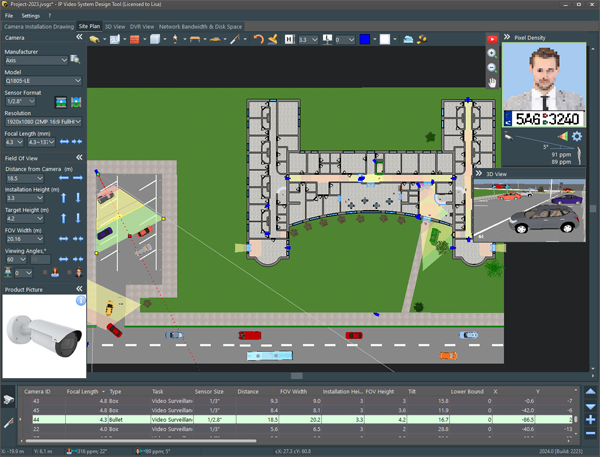
The previous version of this standard is known as EN 62676-4: 2014 (2015) has been supported by IP Video System Design Tool in year 2016. Now the new standard is supported in IP Video System Design Tool and in CCTV Lens Calculator from JVSG.
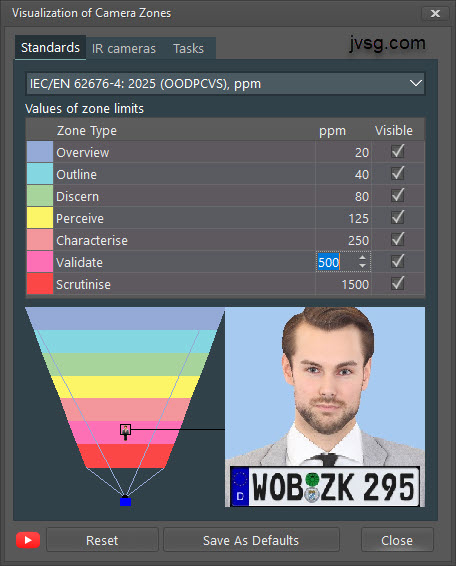

Pic. 1 Visualization of camera zones based on IEC 64676-4:2025 in IP Video System Design Tool 2025 (in previous versions of the program the standard is named IEC 64676-4:2024)
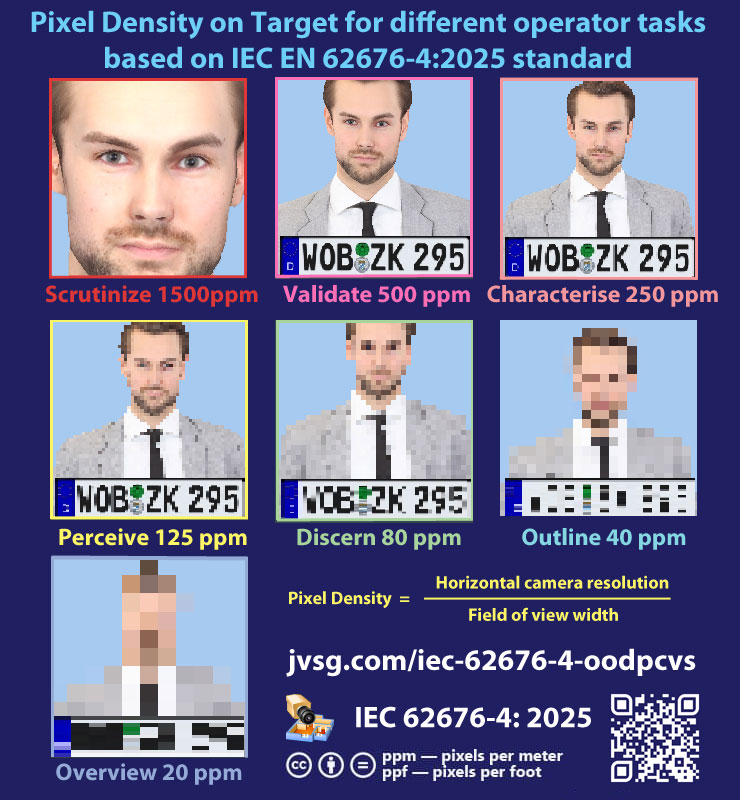
Pic. 2 Infographics of pixel density of Overview, Outline, Discern, Perceive, Characterize, Validate, Scrutinize camera zones (operator tasks) in video surveillance based on IEC 62676-4:2025 standard.
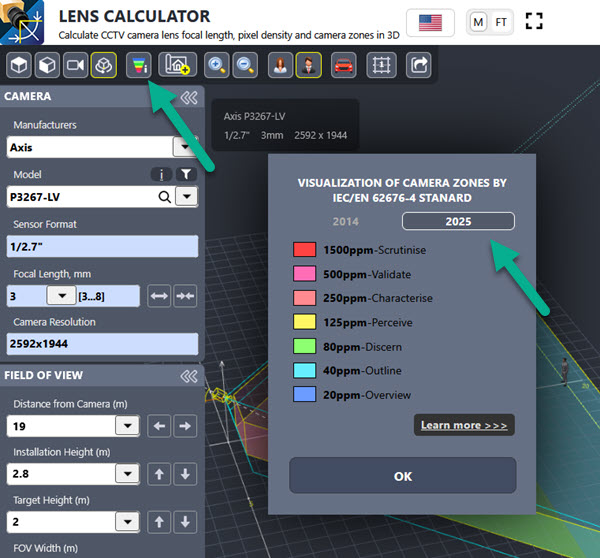
Pic. 3 Visualization of camera zones based on IEC 64676-4:2025 in JVSG CCTV Lens Calculator
Object Size Definitions and Pixel Density
The updated standard categorizes pixel densities into two main groups: Low Pixel Density Object (LPDO) and High Pixel Density Object (HPDO). This categorization is based on practical tests conducted with contemporary surveillance cameras equipped with various sensors and pixel resolutions under different illumination levels.
| Group name | Category | Pixel densities (Pix/m) |
| Low Pixel Density Object | O/O/D | 20/40/80 |
| High Pixel Density Object | P/C/V/S | 125/250/500/1500 |
Low Pixel Density Object (LPDO)
- Overview: To display moving objects at far distances, a minimum of 20 pixels per meter (pix/m) is required. This allows for basic perimeter detection and border control applications.
- Outline: For outlining moving objects and their direction, at least 40 pix/m is necessary. This is useful for tracking object movements.
- Discern: To discern targets or crowds at a distance, more than 80 pix/m is required. This level of detail helps in identifying movements of people, vehicles, or animals.



High Pixel Density Object (HPDO)
- Perceive: To perceive targets or crowds, a minimum of 125 pix/m is required. Although people cannot be differentiated by gender (Max comment: I am actually not sure about that! Could it be a mistype on page 31 of the standard?), their movements can be tracked.
- Characterize: Characterizing people and vehicles requires more than 250 pix/m. This level allows for identifying person type, gait, behavior, and vehicle category.
- Validate: For validating known persons or reading vehicle license plates, over 500 pix/m is necessary. This is also sufficient for most automatic face recognition software.
- Scrutinize: To scrutinize people, capturing at least 1500 pix/m is essential. This ensures high certainty in identifying individuals and recognizing vehicle details like model and year of manufacture. The value for Scrutinise is based on the equivalency of passport photo size of a person.




Security Concept
The new standard requires a security concept as a basis for planning a video surveillance system. The security concept shall include the VSS as part of a three-pronged security strategy which consist of
- Structural-mechanical measures
- Electronic measures
- Organisational measures
The structure of the security concept should follow the sequence of hazard
assessment, risk assessment which then results into definition of risk treatments. This
should help to better define the security gradings of video surveillance system and support end
users/operators in the planning and installation of secure VSS.
IP Video System Design Tool helps to create Security Concept of video surveillance system using 3D camera planning, calculating pixels per meter and displaying camera zones for different operator tasks.

Practical Implications
The new standard draws from the ISO/IEC 19794-5 and ISO/IEC 29794-5 standards and integrates findings from practical tests. Special attention was given to details at lower illumination levels, and the impact of compression was also considered. The standard ensures that video surveillance systems are equipped to handle real-world scenarios more effectively, providing higher accuracy and reliability.
Conclusion
The IEC/EN 62676-4: 2025 (OODPCVS) standard represents a considerable step forward in video surveillance technology. By establishing clear guidelines for pixel density based on object size and application, it ensures that surveillance systems can deliver detailed and accurate imagery, enhancing security and monitoring capabilities.
Video surveillance design software
Visualization of camera zones based on IEC 64676-4:2025 in JVSG CCTV Lens Calculator
Launch CCTV Lens Calculator
This article is written by:
More: IEC Website. (TC79/WG12)
Article updated: February 2026