

Attract More Customers
- In today’s competitive environment, having new customers constantly is one of the keys of success. With this software tool you can make professional quotes with proper sketches, realistic test objects, 3D images, mock ups etc, which leave a lasting impression on your clients.
- Explain to your customers that they can reduce costs by optimum utilization of cameras where they can get better utilization of the hardware and also reduce blind spots and coverage gaps thus increasing level of security.
- When you are answering queries related to your product, you can quickly glance through the details while your client is on call.
All these factors go a long way to earn and retain new clients along the way.
Design video surveillance systems quickly and easy
- “A picture is worth a thousand words” goes the old and equally wise saying. It is true that most human beings learn much quicker when aided by visuals rather than pure text as that is more in tune with the human psychology of learning.
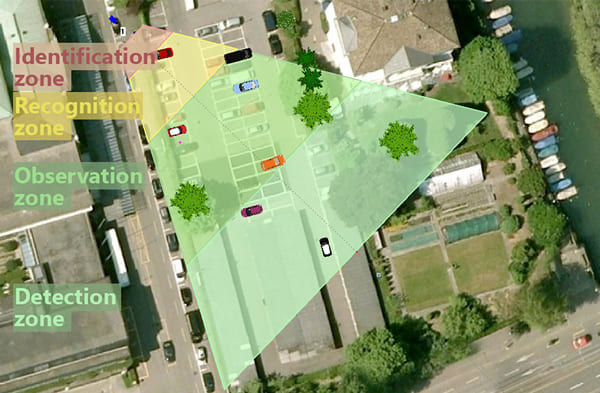
Our program takes full advantage of this concept and displays the information in an intuitive and easy to remember manner. So instead of remembering commands and functions you will easily remember that yellow color indicates areas where it is possible to recognize people, red color indicates areas suitable for people identification, green areas for detection and so forth.
Please read Pixel Density, PPF, and PPF in Video Surveillance article.
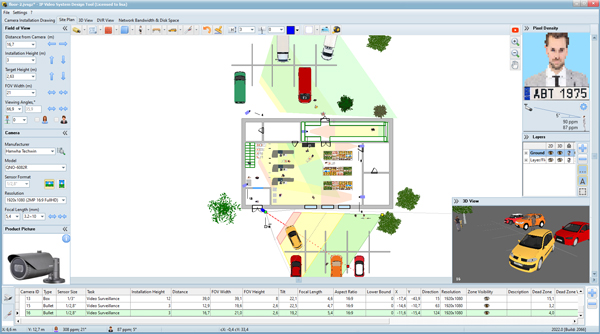
- The cut, copy, paste and move functions are very familiar to all PC users and come naturally to them, hence do not require any learning curve. The processes also follow the natural logical pattern so say for example if you have to insert a window in a wall, simply drag the window onto the position and it will get inserted in the wall just like building blocks.
- There is a 30 level Undo function which helps you to go back in case you seem to be on the wrong design path, thus tracing your steps backwards one at a time.
Encourage customers to spend more
Cost savings is often a priority but not always so, especially in the area of security. So when your customers are not convinced why they should purchase more and/or better cameras than the ones they want, you can always explain visually that how better cameras can lead to better identification of people and corresponding increase in security.
It might seem a small increase in percentage of expenditure at the outset but it helps to save lot more money in the long run by providing better security and preventing many possible mishappenings.
Increase Customer Loyalty
Getting new customers is just one side of the coin; if these customers are not satisfied and not retained, it will just be useless to keep acquiring new customers when they do not return. Hence building a loyal customer base is the sure short way to success.
IP Video System Design Tool software helps to keep your customers satisfied by taking care of all their requirements. Communication is vital in any business transaction and any gap or misunderstanding in the same leads to loss of time, reputation and the client itself.
Hence you can always use this software to provide the best demos and make sure that communication is complete in all respects such as understanding their needs, aspiration and demands.
Do you still need any more proof as to why should you invest in JVSG tool?
Just click here and read user reviews and comments.
92% of customers who took part in the recent customer survey specified that they will recommend the program (64% choose Very Likely and 28% chosen Likely).
White Paper: From CCTV Pre-visualization of Design to Fruition – by Jay C. McCormick  PSP, CAHSO, ESCO Communications


What is new in the latest version?